
How to Brush Your Cat’s Teeth: A Step-by-Step Guide for Pet Parents
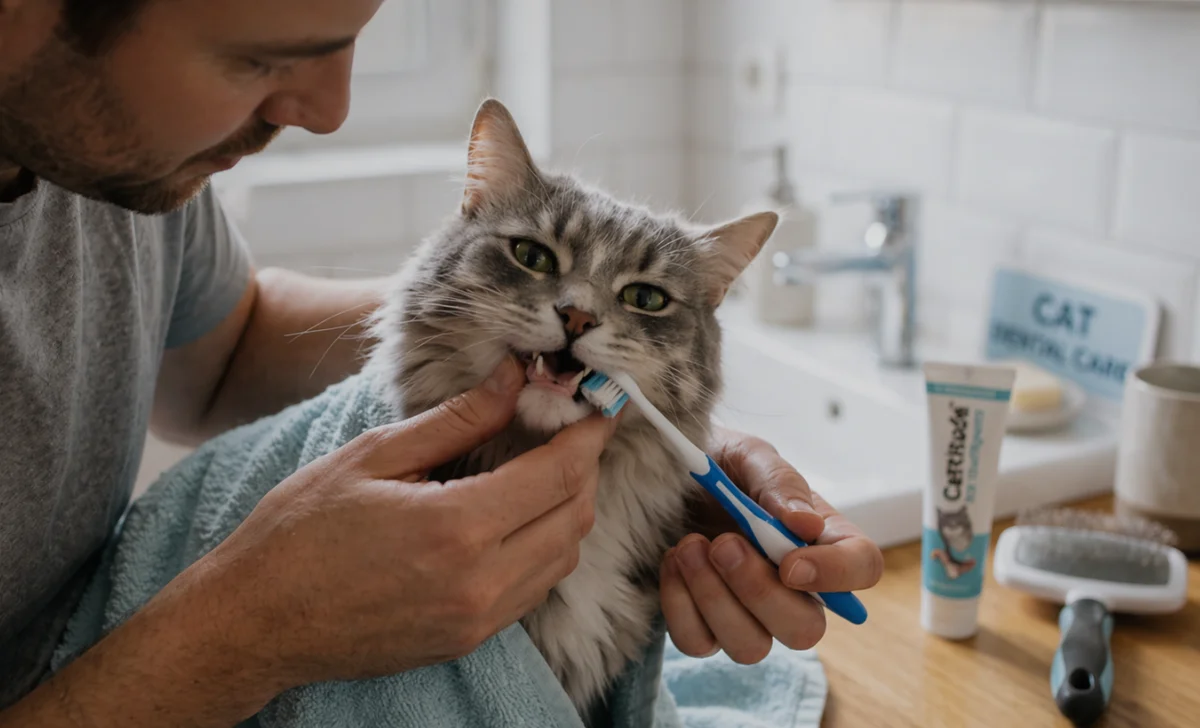
Learning how to brush your cat’s teeth daily is essential for every cat owner, as about 70% of cats over four years old suffer from periodontal disease, and brushing is the best way to prevent it. This article will provide a professional-level guide to daily oral care for cats, explaining why oral care is important and how to brush your cat’s teeth in detail.
Why is oral care important for cats?
Identifying the “Three Major Killers” of Oral Health
Dental plaque: Dental plaque is a sticky, thin layer of germs that builds up on teeth within one to two days after a meal. If not removed promptly by brushing or other methods, it gradually calcifies into tartar.
Tartar: If dental plaque is not removed in time, it combines with minerals in saliva within 24-48 hours, gradually calcifying into tartar. Tartar has a rough surface, attracting more bacteria to accumulate, and once formed, it is difficult to remove with ordinary household brushing.
Periodontal disease: This is the most serious consequence of neglecting oral hygiene. Bacteria can invade below the gum line, damaging the supporting structure of teeth, leading to loose teeth, tooth loss, and even systemic bacterial infections.
Therefore, daily oral care is very important, and brushing is the most effective method.
What to use to brush cats teeth?
Choosing the right tools before brushing your cat’s teeth is a crucial step, as it directly affects their cooperation, the effectiveness of brushing, and even their safety. Therefore, please read carefully.
Choosing a Cat Toothbrush
Finger Toothbrush: For new pet owners and cats trying brushing for the first time, learning to use a finger toothbrush is a good choice. This type of toothbrush fits like a glove on your finger, providing a natural and clean feel for both owner and cat, making it more acceptable to the cat.
Soft-bristled Toothbrush: Once your cat no longer objects to touching its teeth, you can start using a dedicated soft-bristled toothbrush. The long handle design of this type of toothbrush allows it to reach hard-to-reach back molars for a deeper clean.
Never use human toothbrushes and toothpaste
Can I use a human toothbrush to brush my cat’s teeth? The answer is no. Human toothbrushes usually have heads that are too large and bristles that are too stiff, easily injuring a cat’s delicate gums.
Similarly, human toothpaste is also not recommended. Human toothpaste often contains fluoride or xylitol, which are highly toxic to cats. Since cats don’t rinse their mouths, swallowing these ingredients can lead to serious health problems.
It is recommended to choose cat-specific toothpaste. This type of toothpaste is usually designed with flavors that cats like, making it not only safe but also potentially having a positive stimulating effect.
Ever wonder how to safely scrub your kitty’s fangs inside your own house?
After selecting the tools, you can begin the practical part. Getting a cat used to tooth brushing takes slow, step-by-step training. Don’t expect to achieve a deep clean on the first try; you need to build trust step by step to prevent the cat from becoming wary of brushing.
Four Gradual Steps:
- Step 1: Taste Adaptation. Let the cat try the taste of the cat toothpaste and gradually become familiar with it. You can squeeze toothpaste onto your finger and let the cat lick it clean like a treat.
- Step 2: Touch Practice. When the cat is relaxed, try gently lifting its lips. If there is no resistance or discomfort, you can slowly try touching its teeth and gums. If the cat resists, stop immediately. If it cooperates, reward it with a treat.
- Step 3: After your cat has adapted to the first two steps, you can start using a finger toothbrush or a soft-bristled toothbrush to try brushing its teeth for the first time. It’s recommended not to try brushing all its teeth at once during the first attempt.
However, if your cat shows any discomfort, stop immediately. For brushing technique, watch professional cat brushing tutorial videos to learn the correct method of cleaning at a 45-degree angle towards the gum line.
- Step 4: Establish a daily routine. Once your cat no longer resists brushing its teeth, you can try brushing all its teeth each time, eventually establishing a daily brushing habit, at least three times a week.
The “3-3-3 Rule” for Brushing Your Cat’s Teeth
Many cat owners give up after the first few days. The 3-3-3 guideline helps you create achievable goals and slowly earn your cat’s confidence.
The first 3 days: Adapting to the taste and touch. The theme for these 3 days is “desensitization.” The focus is on getting your cat used to having its mouth touched and developing a liking for the taste of toothpaste, without any actual brushing action.
The next 3 weeks: Adapting to the brushing action. During these 3 weeks, you can start using tools and gradually transition from the canines to the back molars. This is not only an adaptation period for your cat but also a crucial period for you to practice your brushing techniques.
Persist for 3 months: Forming a lifelong habit. By the third month, brushing will become a part of your cat’s life. At this point, your cat’s oral health will significantly improve, and bad breath will be noticeably reduced.
How to Brush a Cat’s Teeth with Gingivitis
Cats with gingivitis have very sensitive mouths, requiring extra care and a more delicate brushing technique. If you ignore it, the condition can turn into permanent gum and bone damage.
Identifying Gingivitis: Before starting oral care, observe the cat’s mouth. Healthy gums should be pale pink, while the most obvious symptom of gingivitis is a reddish band around the gum line, accompanied by noticeable redness and swelling.
Abnormal Reactions: If a cat frequently drops food, drools excessively, or refuses to touch its mouth while eating, it may be experiencing gingivitis.
Special Care Techniques
Tool Optimization: When cleaning the mouths of cats with gingivitis, softer tools are needed. Finger toothbrushes are typically used instead of long-handled toothbrushes. Finger toothbrushes allow for better control of finger pressure, and their silicone material provides a gentler cleaning.
If a finger toothbrush is unavailable, soak the bristles in warm water before using a soft-bristled toothbrush to further soften them. Dental wipes and dental powder can also be used as supplementary methods.
Technique Upgrade: When cleaning, brushing motions need to be very gentle. Use only enough pressure to allow the toothpaste to contact the tooth surface, avoiding pressure on inflamed gums. Clean only 1-2 teeth at a time. Plaque most easily accumulates at the gum line; apply toothpaste only along the gum line for initial cleaning.
What to do when your cat refuses to have its teeth brushed?
If your cat consistently refuses to cooperate with brushing, you can try the following suggestions:
Try alternatives: After consulting a veterinarian to confirm that your cat’s oral health is normal, you can use dental gel, dental cleaning agents, or water supplements as supplementary methods for cleaning.
Seek professional help: For cats with severe periodontal disease or gingivitis, brushing may cause severe pain. Please ensure that a veterinarian diagnoses and treats the condition first.
When should you stop home care and consult a veterinarian?
Taking care of your cat’s teeth at home helps prevent issues, but it is not a substitute for expert veterinary treatment. If your cat exhibits any of the following, be sure to have it checked by a veterinarian:
Severe odor : This usually means bacteria have penetrated deep into the periodontal tissues.
Refusal to eat: Gum pain prevents the cat from chewing hard foods.
Persistent gum bleeding: Even a very slight touch can cause bleeding.
FAQs:
Do cats really need their teeth brushed?
Yes, absolutely. While wild cats can sharpen their teeth by biting prey, domestic cats, who eat soft foods, are prone to plaque buildup. If their teeth aren’t brushed regularly, bacteria will turn into tartar, eventually leading to periodontal disease. Brushing is currently the most effective and cost-efficient way to prevent oral health problems in cats.
I’ve never brushed my cat’s teeth before, is it too late to start?
Sure, you can begin whenever you like—just make sure you’ve mapped out a smart strategy first. If you have an adult cat that has never tried brushing its teeth before, it’s recommended to take it to a veterinary clinic for a checkup first.
If your cat already has severe tartar buildup or gingivitis, brushing directly may cause severe pain. After the veterinarian has assessed the cat’s oral health, you can use the 3-3-3 rule to rebuild its adaptation.
How to keep your cat’s mouth clean without ever picking up a toothbrush?
While brushing is the “gold standard,” if it’s not feasible, consider the following alternatives:
Dental cleaning supplements: Add dental cleaning solution to their drinking water.
Prescription dental food: Uses special granules to physically abrade the tooth surface.
Professional dental cleaning: Regularly take your cat to a veterinary clinic for ultrasonic dental cleaning to thoroughly remove tartar.
