
How German Luxury Automakers Build Prestige Beyond the Factory
By James Tanoos, Clinical Associate Professor, Purdue University
Consumer behavior is shaped by both psychological and sociological influences. Although luxury brands command premium prices, the concept of luxury ultimately depends on consumers’ perceptions of prestige, status, and symbolic value rather than price alone. Luxury brands illustrate how prestige and exclusivity can become as influential as functional quality in driving purchasing decisions.
“Brand image plays a significant role in influencing consumer loyalty and purchase behaviour” (Nunes, 2024, p. 237). Similarly, luxury automobile brands are closely tied to consumer psychology in that purchasing decisions are motivated not only by transportation needs but also by emotional, social, and symbolic factors.
Luxury vehicles are generally defined as those valued at over $150,000 sticker price and (Bertoncello et al.) stated “The most famous brands have instantly recognizable, iconic designs that set future trends” (2024; para. 1). Consumers often purchase these vehicles to communicate achievement, identity, success, and social status.
Perceptions of how they are viewed by friends, colleagues, and society also play a significant role in the decision-making process. Purchasing and driving a luxury vehicle is a method for consumers to express identity, signal social status, demonstrate personal accomplishment, or associate themselves with qualities such as success, prestige, exclusivity, craftsmanship, and engineering excellence.
Manufacturers invest heavily in shaping consumer perceptions, experiences, and emotional connections, making psychological and sociological influences central to their branding and marketing strategies.
This emphasis on long-term brand relationships is reflected in customer loyalty, with 37% of luxury automobile buyers identifying as brand loyalists who are likely to make a repeat purchase (McKinsey, 2025, para. 4). “The premium marquees … must develop attributes and values that reflect changing social values which influence buyers emotionally” (Anurit et al., 2008, p 749).
These motivations are especially relevant to German luxury automobile brands, whose value extends well beyond transportation. Consequently, manufacturers invest heavily in museums, showrooms, and brand experience centers that reinforce these psychological associations by showcasing their heritage, craftsmanship, innovation, and exclusivity, thereby strengthening the prestige and emotional value attached to their brands.
A recent trend in the German luxury automobile industry has been the integration of various customer centers near their flagship factories. These venues increasingly serve as advertising and promotional extensions of multinational automobile brands, transforming past, present, and future luxury vehicles into exhibits that convey each organization’s values, evolution, innovation, and cultural impact.
This approach is especially important for luxury brands, which rely on emotional connections rooted in elite status, prestige, and exclusivity. By extending the brand experience beyond the manufacturing site, these facilities allow customers to engage with the brand’s heritage, craftsmanship, and technological achievements while strengthening long-term emotional connections.
They also function as powerful marketing tools that attract prospective buyers by presenting a compelling narrative of the company’s history, innovation, and legacy. Increasingly, these venues serve as catalysts for charity events, new model launches, enthusiast gatherings, and other brand experiences that reinforce customer affinity and position the manufacturer as more than simply a vehicle producer.
In the psychology of consumer behavior, the prestige of luxury products is deeply rooted in emotion, as consumers use these goods as sentimental and social tools to construct their self-identity and validate their status and who they are as a person. Veblen’s (1899) concept of conspicuous consumption explains that individuals buy highly visible, expensive goods to flaunt their wealth and actively assert their social prestige.
This habit of purchasing premium goods is tied to subjective, intangible rewards rather than functional utility. Expanding on interpersonal psychological effects, Leibenstein’s (1950) theory of demand for network effects highlights how consumer motivation is driven by exclusivity; specifically, the snob effect refers to how demand for a luxury item increases simply because it is rare and out of reach for the general public, elevating the perceived prestige for the owner.
Germany is particularly well-suited to the development of museums and showrooms near flagship factories because of several national cultural characteristics. First, Germans place a strong emphasis on engineering excellence and technological innovation, making these facilities ideal settings for showcasing both the historical evolution and future direction of automotive research and development.
Germany has a global reputation for engineering excellence through a long tradition of precision manufacturing, technical education, applied scientific research, and close collaboration between industry and universities, producing innovations across the automotive, machinery, chemical, and industrial sectors.
German culture emphasizes quality, reliability, efficiency, and continuous improvement, making engineering achievement and its longtime “made in Germany” hallmark a central element of German national identity and a key source of its international economic competitiveness.
Second, German consumer culture tends to be more utilitarian than hedonic with respect to public purchasing behavior, traditionally placing greater emphasis on practicality, durability, and restrained consumption than on overtly hedonic or pleasure-driven purchasing (Hirschman & Holbrook, 1982; Hofstede et al., 2010).
However, an exception has always been made for luxury domestic vehicles as a method to display social status and material wealth rather than clothing, jewelry, or collectibles. Although public displays of wealth are generally moderated by cultural values emphasizing modesty, practicality, and social equality, luxury automobiles occupy a unique position because they symbolize engineering excellence, craftsmanship, technological innovation, performance, and national industrial achievement as opposed to conspicuous consumption alone.
Consequently, owning domestic luxury brands is often viewed as a socially acceptable expression of achievement that aligns with broader German cultural values. Nunes (2024) found that there were strong connections between the brand personality of a luxury vehicle company and the desire to buy and recommended that organizations should build compelling brands that align with consumer tastes.
This cultural acceptance helps explain why luxury automobiles remain among the country’s few highly visible status symbols, a trend that has developed over time to give a distinctive cultural environment for domestic consumer appeal for luxury automobiles.
These cultural and psychological dynamics help explain why German luxury automakers invest heavily in flagship showrooms, brand centers, and museums beyond their manufacturing facilities. In addition to functioning as sales outlets, these venues serve as strategic brand-building assets that immerse visitors in the company’s heritage, technological innovations, motorsport achievements, design philosophy, and future vision.
By creating memorable experiences in prominent urban locations and tourist destinations, manufacturers reinforce perceptions of prestige, exclusivity, quality, and innovation while strengthening long-term customer loyalty and attracting future buyers who may not yet be in the market for a vehicle. In doing so, these facilities transform the luxury automobile from a consumer product into a cultural artifact and an experiential symbol of the country and brand itself.
Four German luxury brands are especially known for their prestige and status: Audi, BMW, Mercedes-Benz, and Porsche. All four of these organizations have spent resources and energies on their showrooms and museums outside their flagship factories in Germany.
| Luxury German Auto Organization | Tagline | Core Image |
| Audi | Progressive Sophistication | Technological innovation with understated luxury |
| BMW | Driving Pleasure | Driver-centric luxury with dynamic performance |
| Mercedes-Benz | Timeless Luxury | Traditional luxury fused with modern innovation |
| Porsche | Precision Performance | Heritage-driven performance with modern luxury |
Adjacent to Audi’s flagship production complex in Ingolstadt, Germany, is the Audi Forum and three-story Audi Museum Mobile located inside, which serve as an epicenter for brand engagement, heritage, and technological innovation. Opened in 2000, the complex was designed to connect visitors directly with the company’s manufacturing operations through vehicle deliveries, factory tours, exhibitions, and customer experiences, reinforcing Audi’s reputation for excellence in engineering and technological advancement.
The complex chronicles more than a century of automotive history, including the origin story of the brands that merged to form the historic Auto Union that created Audi in 1932. The complex showcases motorsport achievements and landmark vehicle designs and highlights modernizations in electrification, sustainable mobility, digital technologies, autonomous driving research, and Audi’s transition toward software-defined electric vehicles, displaying both the company’s heritage and its future vision.
BMW’s showroom, BMW Welt, as well as their museum, are located beside BMW’s headquarters and factory complex. BMW Welt was conceived as a futuristic brand-experience and vehicle-delivery center. It opened in 2007 with the goal of connecting customers directly with BMW’s products, technology, and manufacturing heritage.
Its modern glass-and-steel architecture was intended to showcase innovation, mobility, and customer engagement while serving as a gateway to the adjacent factory and headquarters. Across the road, the BMW Museum originally opened to coincide with the ’72 Olympic Games and has since expanded, preserving BMW’s history through classic vehicles like Elvis Presley’s 1957 BMW 507 Roadster as well as motorcycles, engines, and milestone designs.
Together, the two facilities illustrate BMW’s evolution from an engineering-focused manufacturer to a technology-driven mobility company, with recent exhibits emphasizing electric vehicles, sustainability, digital connectivity, and the company’s “Neue Klasse” vision for next-generation electric and software-defined vehicles.
Mercedes-Benz’s brand experience museum facility in Stuttgart Germany, is about 20km away from their flagship factory. It was established to celebrate the company’s history while strengthening connections between the brand, its products, and visitors, as well as to present the company’s role in automotive history through an immersive chronological and thematic experience, tracing developments from the invention of the automobile to modern mobility.
Visitors commonly take both the flagship factory tour as well as the adjacent customer center (Kundencenter Sindelfingen) in Sindelfingen, Germany, which showcases both the company’s historical legacy and its current vehicle production. The Kundencenter allows visitors to connect the brand’s heritage with its contemporary manufacturing operations.
It is designed as a customer experience and vehicle handover facility where buyers can take delivery of their new vehicles directly from the factory. In recent years, it has expanded its focus to highlight electric mobility, digital vehicle technologies, and sustainable manufacturing practices as Mercedes-Benz transitions toward a more electrified future.
The Kundencenter also hosts events such as the unveiling of new models and vehicle launches, roadshows and corporate events, receptions, and conferences.
Located beside Porsche’s Stuttgart-Zuffenhausen factory are the Porsche Museum and visitor facilities, created to celebrate the brand’s heritage while deepening customer engagement. Opened in 2009, the museum highlights Porsche’s history, engineering innovations, motorsport achievements, and iconic sports cars.
Nearby facilities offer factory tours, vehicle deliveries, exhibitions, racing simulators, and special events, linking the company’s legacy to its modern production operations. It shares the story of Ferdinand Porsche’s early engineering work and the first Porsche sports car (the 356 No. 1 Roadster) as well as legendary Le Mans-winning race cars, Formula 1 machines, concept cars, and modern supercars like the 918 Spyder.
Recent exhibits emphasize electrification, sustainability, battery technology, e-fuels research, and the Taycan, showcasing Porsche’s vision for high-performance electric and hybrid mobility.
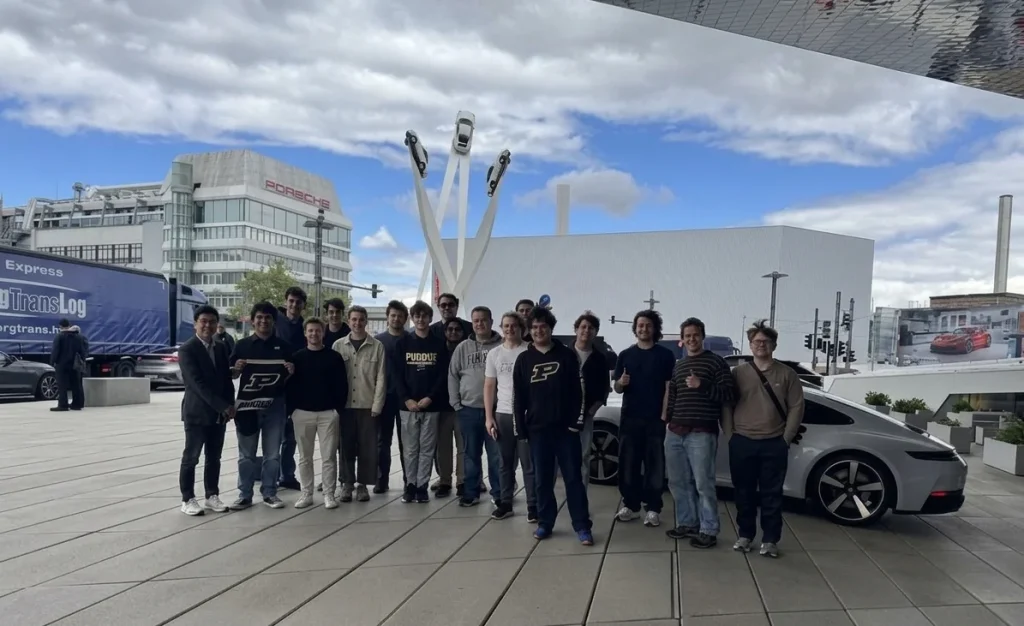
As part of the study abroad curriculum, students from Purdue University have visited these museums, showrooms, and visitor centers as part of their tours of the flagship factories. Notable to these students is the connection between the past, current, and future of these brands, as displayed at these venues.
These emotional investments among luxury German automobile brands have supported their intangible value. Bertoncello et al. (2024) found that 91% of respondents rated heritage, or the historical connotation of a luxury vehicle, as somewhat or very important in the purchase decision. While brand value can be difficult to quantify, recently, some independent organizations have attempted to measure these perceptions.
Because brand value and consumer perceptions are inherently difficult to quantify, these organizations have increasingly published consumer survey reports to measure how evolving social values, emotional associations, and perceived brand attributes influence purchasing behavior.
Annual research and published rankings reflect the psychology of prestige that these brands have built up over the years, and more importantly their related pricing power and desirability. These consumer behavior viewpoints are vital to future sales of luxury vehicles, since these perceptions are essential to success in the premium automotive segment.
These surveys and published research reports reflect those attitudes and represent everything that these brands have done over many years, including the development of their museums, showrooms, and customer centers to enhance their reputations.
- Interbrand, a US/UK-based brand consultancy organization that estimates the financial value of a brand as an intangible asset related to financial performance, publishes a “Best Global Brands” ranking. This survey integrates the intrinsic role of the brand, plus its strengths, such as customer loyalty and repeated sales.
- The annual BILD brand “Attractiveness” survey, conducted by mobile.de, a popular German online vehicle marketplace, asks which luxury automakers Germans find most appealing or attractive in terms of emotional appeal, consumer perception, and general desirability of vehicles in the country.
- Consumer Reports is a popular magazine whose annual report on luxury vehicles is based on owner satisfaction measured by how happy current owners are with their vehicle and whether they would buy the same brand again. This report might ask a question such as “If you had it to do over again, would you definitely buy or lease the same vehicle?”
- J.D. Power’s “Brand Loyalty” survey assesses how many actually return and purchase or lease another vehicle from the same brand when they replace their current vehicle.
- The “Owner Satisfaction & Repurchase Intent” survey is published by Kelley Blue Book, an American vehicle valuation and automotive research company, in conjunction with Consumer Reports. It quantifies owner satisfaction and repurchase intent to determine the likelihood that owners might choose the same brand if they were buying a new automobile today.
- The “UK Prestige via YouGov Brand Index Purchase Funnel” is administered to adults in the UK. This public tracking framework is used by marketers to map how consumers move from recognizing a brand to actually buying it and measures brands on four categories: awareness, consideration, purchase intent, and conversion.
- “Perceived Quality & Prestige in the US” is a US/Canadian organization measuring subjective consumer beliefs about automotive brands, surveying North American consumers to gauge luxury automobile brand reputation, and is reflective of strong perceived quality, reliability, desirability, and residual value.
- “Status Symbol Perception in Germany” (8) is another mobile.de study based on German public perception of prestige and social status. It measures the connection of the brand with luxury and its reputation among German consumers.
Survey #1’s score was converted to a 0–100 scale, as Mercedes-Benz was rated highest among the four brands and therefore assigned the highest-value brand at 100. The normalized brand-value score was then averaged with the other available percentage/index scores.
Survey #4’s score for Audi and survey #6’s score for Porsche were excluded from the total because there was no data available, instead of counting against the brand. These eight surveys were then utilized to determine a composite “Average Prestige Score”.
| Luxury German Brand | Interbrand’s Best Global Brands | Attractiveness | Consumer Reports | Brand Loyalty | Owner Satisfaction & Repurchase Intent | UK Prestige via YouGov Brand Index Purchase Funnel | Perceived Quality & Prestige in the US | Status Symbol Perception in Germany | Average Prestige Score |
| Audi | $17.3B (#45) | 16% | 65 | No data | 59% | 19.5% | 65.9 | 27% | 36.2 |
| BMW | $52B (#10) | 20% | 72 | 55.8% | 76% | 14.1% | 68.7 | 42% | 54.0 |
| Mercedes-Benz | $59B (#8) | 18% | 64 | 49.0% | 59% | 13.5% | 70.2 | 53% | 53.3 |
| Porsche | $17B (#43) | 17% | 80 | 57.5% | 76% | No data | 68.1 | 52% | 50.1 |
These eight published surveys by respected institutions best represent a quantitative analysis of brand prestige for these luxury German automobile organizations from the perspective of the consumer. Aggregate scores found that BMW scored highest at 54.0, followed closely by Mercedes-Benz (53.3), then Porsche (50.1), and Audi (36.2).
German luxury automobile manufacturers have successfully transformed museums, showrooms, and customer visitor centers into strategic extensions of their brands, reinforcing prestige, heritage, and emotional attachment while complementing their flagship manufacturing facilities. These experiential venues strengthen consumers’ perceptions of their engineering excellence, exclusivity, and brand identity, contributing to long-term customer loyalty and intangible brand value.
Collectively, the prestige rankings and consumer perception surveys illustrate the tangible and intangible investment in brand image, and demonstrate that sustained investment in brand experiences beyond the factory has become an important competitive strategy for Audi, BMW, Mercedes-Benz, and Porsche in maintaining their global luxury positioning.
References
Anurit, J., Newman, K., & Chansarkar, B. (2008). Consumer Behaviour of Luxury Automobiles: A comparative study between Thai and UK customers’ perceptions. Journal of Consumer Marketing Management, 14, 749-763.
Auto Remarketing. (2014, June 4). Survey: Honda, Mercedes-Benz deliver highest quality vehicles. https://www.autoremarketing.com/ar/analysis/survey-honda-mercedes-benz-deliver-highest-quality-vehicles/
Bartlett, J. S. (2025, December 4). Which brands make the best cars? Consumer Reports. https://www.consumerreports.org/cars/cars-driving/which-brands-make-the-best-cars-a6159221985/
Bertoncello, M., Hertzke, P., & Middleton S. (2025, March). Shifting gears: What buyers are saying about the luxury-car experience. https://www.mckinsey.com/industries/automotive-and-assembly/our-insights/shifting-gears-what-buyers-are-saying-about-the-luxury-car-experience
BILD. (2024, July 23). Partnersuche: Diese Automarken erhöhen ihre Flirt-Chancen.
Chance, J. (2021, October). The psychology of luxury car buyers. Beverly Hills Magazine. https://www.beverlyhillsmagazine.com/the-psychology-of-luxury-car-buyers/
Hirschman, E. C., & Holbrook, M. B. (1982). Hedonic consumption: Emerging concepts, methods and propositions. Journal of Marketing, 46(3), 92–101.
Hofstede, G., Hofstede, G. J., & Minkov, M. (2010). Cultures and organizations: Software of the mind: Intercultural cooperation and its importance for survival (3rd ed.). McGraw-Hill.
Interbrand. (2024). Best global brands 2024. https://interbrand.com/best-global-brands/global/2024-report/
J.D. Power. (2024, September 25). 2024 U.S. Automotive Brand Loyalty Study. https://www.jdpower.com/business/press-releases/2024-us-automotive-brand-loyalty-study
Leibenstein, H. (1950). Bandwagon, snob, and Veblen effects in the theory of consumers’ demand. The Quarterly Journal of Economics, 64(2), 183–207.
Nunes, L. (2024). Impact of brand image on consumer buying behavior towards luxury automobile segment. International Research Journal on Advanced Engineering and Management, 2(03), 237–247.
Veblen, T. (1899). The theory of the leisure class: An economic study in the evolution of institutions. Macmillan
YouGov. (2025). YouGov BrandIndex: Purchase funnel and brand perception metrics. https://yougov.com/business/products/brandindex
