
How to Choose Pet Dental Care Products

Just like humans, pets need daily oral care. Neglecting it can lead to bad breath, oral discomfort, and serious health problems, including but not limited to periodontal disease, loss of appetite, and weight loss.
Choosing the right tools for pet oral care is a complex matter, and finding the most suitable products for your pet is essential for every pet owner. This article will provide a detailed guide to oral care, from selecting the right dental care products to effectively performing oral care.
Pathological Basis
To know how to choose an ideal product, one must first understand the causes and underlying factors of oral diseases, thus enabling targeted treatment. Dental plaque and tartar are not only the causes of various oral diseases but also determine the effectiveness of different products.
Dental plaque
- Causes and mineralization process: After a dog eats, a thin film forms on the surface of its teeth. Over the next 48 hours, bacteria in the mouth continuously absorb nutrients from saliva, eventually forming plaque on the tooth surface and finally calcifying into tartar.
- Continuous need for preventative products: Plaque formation is a continuous process, so any dental care regimen needs to be consistent rather than just occasional cleanings. The golden time to prevent plaque calcification is within 24 hours after eating; whether through brushing or other dental care methods, don’t miss this crucial 24-hour window.
Tartar
- Why you can’t remove tartar at home: Tartar has an extremely strong bond to teeth, and it cannot be removed by brushing your teeth or using oral hygiene products. Forcibly removing it can cause bleeding gums and eventually infection.
- The difference between daily care and professional cleaning: Daily home care can only prevent plaque from turning into tartar and maintain healthy gums. Once tartar has fully formed, the only solution is to go to a veterinary clinic for a thorough cleaning under anesthesia.
Best dog teeth cleaning product
Faced with a wide variety of cleaning products on the market, it can be difficult to know where to start. Here’s how these items split into two distinct groups depending on what they’re made of and how they work.
Physical Removal
These options actually use real physical scrubbing action, which experts agree works better than anything else.
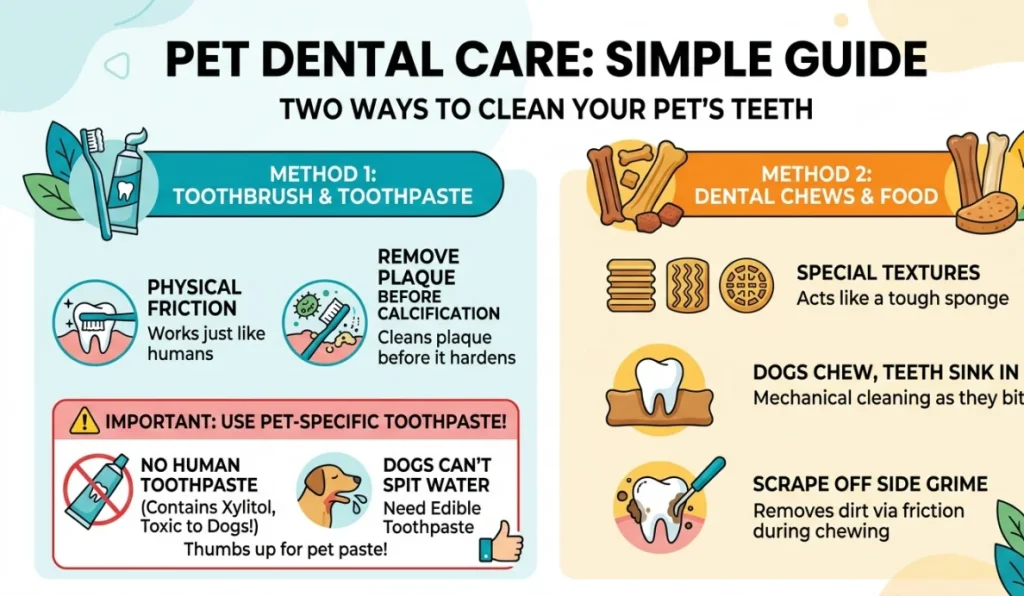
Brushing: Pet toothbrushes and toothpaste work on the same principle as humans, using physical friction to remove plaque before it calcifies. However, it’s crucial that pets use pet-specific toothpaste, as human toothpaste contains xylitol, which is toxic to dogs. Furthermore, dogs don’t spit out saliva, so edible toothpaste must be used.
Best dog teeth cleaning toothpaste:
Type | Element | Effect |
| Enzyme-containing toothpaste | Glucose oxidase, lactoperoxidase | It eliminates bacteria through chemical reactions and can also break down the biofilms that bacteria accumulate on. |
| Toothpaste containing abrasives | silicon dioxide, calcium carbonate | By increasing physical friction, plaque on the tooth surface is removed. |
| toothpaste containing antibacterial and anti-inflammatory ingredients | Chlorhexidine gluconate, zinc | Chlorine gluconate, through chemical action, has a powerful bactericidal effect. Zinc can eliminate bad breath. |
| Ingredient Blacklist Xylitol: It’s extremely dangerous for dogs, leading to a fast crash in blood sugar and serious liver damage. Fluoride: Dogs don’t spit out toothpaste; long-term ingestion of fluoride can lead to chronic poisoning. Foaming Agents: Dogs don’t need mouths full of foam; this can cause gastrointestinal upset and even vomiting. | ||
Dental chews: Excellent dental chews and dental treats are like resilient sponges with special textures. When dogs chew on them, their teeth sink into the chews, and the friction scrapes away dirt from the sides of their teeth.
Chemical Removal
These products don’t rely on force, but on “chemical defense,” making them suitable for pets who absolutely refuse to let their mouths touch anything.
Dental Spray: Dental spray uses active ingredients to change the pH level in the mouth, or directly prevent bacteria from forming a biofilm, acting like a protective film on the teeth, making it difficult for bacteria to establish a home.
Water Additives: Water additives are added to the dog’s drinking water. Their ingredients clean the mouth and inhibit bacterial growth. However, this cannot replace brushing and should only be used as a supplementary method.
Dental Powder: After being absorbed into the intestines, dental powder’s active ingredients are secreted into saliva, disrupting the chemical balance of plaque and making it harder for bacteria to “stick” to the teeth. Long-term use can loosen and brittle existing tartar, making it easier for dogs to remove when chewing on toys or dental chews.
VOHC Certification
When choosing any product, look for the VOHC logo. VOHC is short for Veterinary Oral Health Council — a neutral group made up of top pet dental specialists from around the world. It does not endorse any brand and only reviews experimental data.
Obtaining the VOHC logo for a product is extremely difficult. Manufacturers must provide two independent clinical studies proving either that it effectively reduces plaque buildup or that it effectively reduces tartar formation. Only products that meet the required experimental data can receive this badge.
Vet recommended dog teeth cleaning
Why Veterinarians Recommend Professional Teeth Cleaning
While home dental care can reduce plaque, some problems can only be addressed at a clinic. Therefore, a professional veterinary checkup is recommended at least once a year.
- Subgingival Cleaning: The most dangerous lesions of periodontal disease are below the gum line. Veterinarians use ultrasonic scalers to remove bacteria and tartar that are invisible to the naked eye.
- General Anesthesia: Proper veterinary teeth cleaning must be performed under general anesthesia. This not only prevents pain for the dog but, more importantly, prevents water from entering the trachea and allows the veterinarian to perform a 360°examination of the entire oral cavity.
- Dental X-rays: Over 60% of dental problems are hidden below the gum line (such as periapical abscesses and bone resorption). X-rays are the only way to detect these hidden problems.
Veterinarian-Recommended Home Care Standards
The core goal of home care is to break the 48-hour golden window for plaque to transform into tartar.
Dr. Marty Becker, a renowned veterinarian and top expert in the United States, categorizes home care into three levels: Good, Better, and Best. He also developed the knee test and low-pressure brushing training method.
- Good: Provide your dog with various chew toys and foods, which can effectively remove plaque from the tooth surface through friction. However, he emphasizes avoiding providing overly hard items such as antlers and real bones.
- Better: Add dental floss or dental spray to your dog’s daily drinking water to prevent bacteria from adhering to the tooth surface.
- Best: Brush teeth consistently, ideally once a day, and at least three times a week.
- Knee Test: Before giving your dog a chew stick, tap it with the stick. If it causes pain, it’s too hard for your dog’s teeth.
- Low-Pressure Brushing Method: Dr. Marty Becker advocates turning brushing your dog’s teeth into an interactive moment with your dog, rather than a chore. First, guide your dog to lick the pet-specific toothpaste, then apply it evenly with your fingers, and finally clean it with a finger cot or toothbrush.
In summary:
The choice of tools for daily home grooming of dogs needs to be based on the dog’s specific needs. This affects the dog’s acceptance and the effectiveness of the grooming, ultimately impacting the dog’s health and even life.
As Dr. Marty Becker stated, “Healthy teeth are not just about smelling good; they protect the heart, lungs, liver, kidneys, and brain.” Once germs slip into your blood via sore or bleeding gums, they can travel and harm organs far from your mouth.
