
What Rental Carpet Machines Leave Behind in the Padding
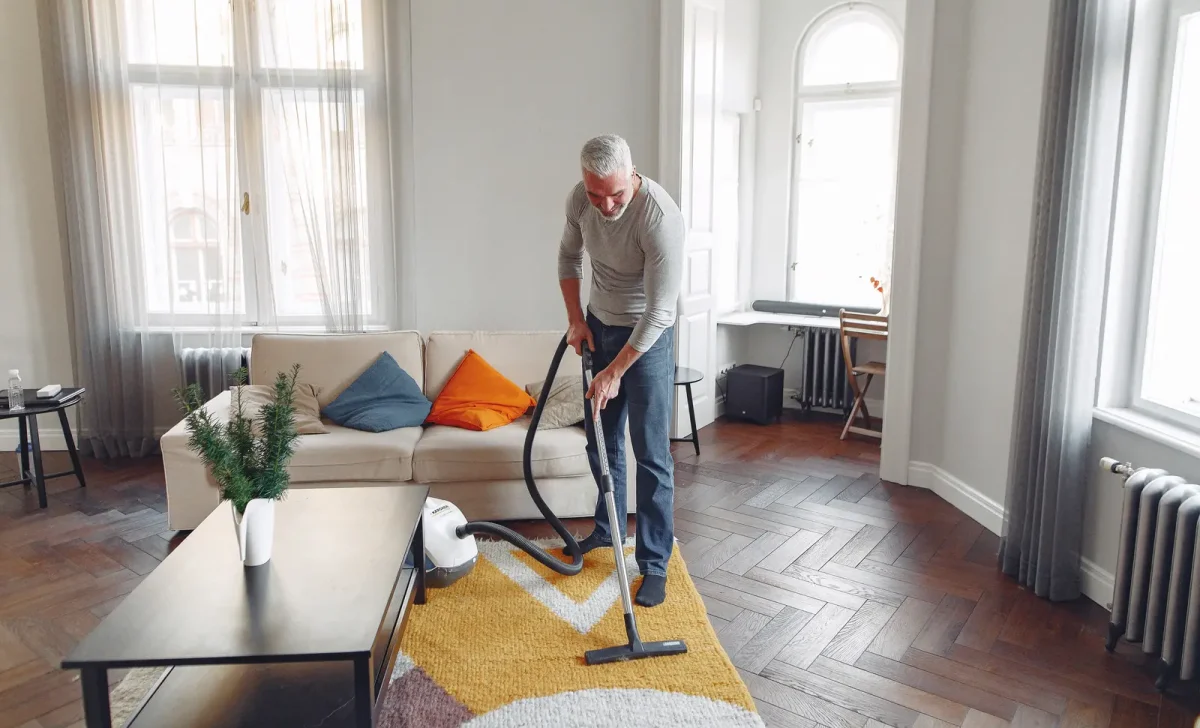
The Saturday Afternoon Plan
The math looks unbeatable. Forty dollars for the machine, twenty for a bottle of solution, an afternoon of your own labor, and a house that would otherwise have cost several hundred to have done. Anyone who has ever pushed one of these units up and down a living room has had the same thought halfway through: this is working, look at the color of the water.
The color of the water is real. Something is coming out. The question that never gets asked on Saturday, and that surfaces about six weeks later when the traffic lanes look worse than they did before, is what stayed in.
Three Numbers That Decide Everything
Extraction cleaning is not complicated in principle. Put solution into the fiber, agitate, pull it back out with the soil suspended in it. The performance of any machine doing that comes down to three specifications, and consumer units are compromised on all three by design rather than by accident.
Water lift is the measure of vacuum strength, how high a column of water the machine can pull. This is the recovery number, and it determines how much of what went down comes back up. Truck-mounted and high-end portable systems operate in a range consumer rental units are not built to approach.
Heat at the jet matters because the chemistry of soil removal is temperature dependent, particularly for oils and greases, which soften and release far more readily when hot. A rental unit heats a small tank or relies on whatever comes out of the household water heater, and that water cools on the way through the hose and the floor.
Airflow carries the moisture out of the fiber during the pass. Low airflow means the pass looks finished while the carpet is still holding a substantial amount of what was applied.
Compromise all three at once and you get the characteristic outcome: the surface looks improved, and a meaningful share of the water is still in the assembly.
Where the Water Goes
Carpet is not one layer. It’s face fiber, a primary backing, adhesive, a secondary backing, and then the pad, which is typically bonded urethane foam and is enormously absorbent by design.
Any liquid applied at the surface that isn’t recovered on the same pass keeps moving down. Gravity does the rest. What ends up in the pad is not clean water, it’s the solution, plus the soil it lifted, plus whatever it dissolved on the way.
That reservoir causes several distinct problems:
- Wicking, where the residue travels back up the fibers as the carpet dries and reappears as spots and lines within a few days
- Detergent residue in the pad, which stays tacky indefinitely and keeps drawing moisture from the air
- Extended drying time, since a saturated pad has almost no airflow across it and dries far more slowly than the face fiber above it
- Microbial growth, which requires only moisture, an organic food source, and time, all three of which are now present
- Delamination, where prolonged saturation weakens the adhesive holding the backings together and the carpet begins to separate in patches
- Odor from below, which is the reason so many DIY jobs are followed a month later by a call about a smell nobody can locate
None of these show up on Saturday. That’s the difficulty with the whole exercise, the feedback arrives too late to connect it to the cause.
The Residue Problem, Specifically
Of everything on that list, detergent residue is the one that most reliably produces the “it looked great, then it got worse” arc.
Most consumer carpet solutions are built around surfactants that are effective at lifting soil and difficult to rinse out without strong recovery. Left in the fiber, they dry into a sticky film. That film is not neutral. It grabs airborne dust and foot-borne grit with real efficiency, and it holds on.
So the carpet resoils faster than it did before it was cleaned. A homeowner who cleaned in March and finds the hallway looking dingy by May concludes, understandably, that the carpet is simply worn out. What’s actually happened is that they installed an adhesive layer across the traffic lane and then walked on it for eight weeks.
Professional work addresses this with a rinse step and, in many cases, a mildly acidic rinse to neutralize alkaline cleaning residue. That step exists precisely because the residue problem is well understood in the trade. It’s the step a rental machine has no mechanism for.
Doing It Anyway, Sensibly
There are situations where a rental unit is a reasonable choice, a single room, a rental apartment before a walkthrough, a spot job on a small area. If that’s the plan, a few things materially improve the outcome.
- Vacuum thoroughly first, in two directions. Most of what’s in a carpet is dry particulate, and it comes out far more easily before water is introduced. Adding moisture to loose grit turns it into mud and drives it in.
- Use less solution than the label suggests. Consumer instructions run generous. Under-dosing costs you a little cleaning power and saves you a great deal of residue.
- Make one wet pass and then several dry passes. Every additional recovery pass with the trigger released pulls out more water. This is the single highest-value habit, and almost nobody does it.
- Do a clear-water pass at the end. Running plain water through the same area and recovering it removes a real fraction of the detergent left behind.
- Move air immediately and keep moving it. Box fans on the floor pointed across the carpet, ceiling fans on, and if the outdoor humidity is lower than indoors, windows open. If it isn’t, run the air conditioning instead, which dehumidifies.
- Check it at the twenty-four hour mark. Press the back of your hand into the pile, and if it’s cool and damp, keep the air moving. Carpet that stays wet past a day and a half is where the real problems start.
Follow all six and a rental unit will do a respectable job on a lightly soiled room. Skip them and the job is likely to be actively counterproductive, which is the outcome that surprises people.
When It’s the Wrong Tool
There are cases where a consumer machine is not a smaller version of professional work but the wrong approach entirely. Pet urine that has reached the pad cannot be resolved from above, because the deposit isn’t in the fiber. Heavy grease near a kitchen needs heat the machine can’t produce. Wool needs pH control and controlled moisture. Anything already treated with several household products needs the previous chemistry removed before new chemistry is added.
And large areas are simply a volume problem. A machine with a small recovery tank, cleaning eleven hundred square feet, is going to put more water into the assembly than it takes out, over and over, for hours.
Service listings for the Charlotte area, including what a professional pass actually includes at the recovery and rinse stage, are available at Acleansteamers.com for anyone comparing the two approaches on more than price.
The Real Comparison
The honest framing isn’t rental versus professional on cost. It’s the total cost including the resoiling cycle, the drying risk, and the shortened life of a floor that was ground down by embedded grit the machine never reached.
A carpet doesn’t usually fail because it was dirty. It fails because it stayed dirty at the base while looking acceptable at the top, and a machine that cleans the tips while filling the pad is, in a specific and measurable way, making that worse.
